The paper behind this story
The Kosher Premium
A family of six that keeps kosher pays thousands more a year at the grocery store. So we priced a thirteen-item weekly basket three ways in one town, item by item, against what the family next door pays. Most of the gap turns out to come from the specialty store rather than from the faith. Buy your certified staples where everyone else does, and the real kosher premium is only meat.
Three bars below, one for each way of filling the same cart. Each bar starts at the neighbor's price and runs right, so a longer bar is a bigger premium.
An original price dataset collected by hand from in-store and published grocery prices across the Five Towns of New York, Los Angeles, Denver, and Chicago, for a thirteen-item weekly basket priced against a national non-kosher baseline. Every kosher item is matched to its ordinary counterpart barcode for barcode, and the two largest markets were cross-checked at a second kosher store to separate a city's price from a single shelf's.
When the check arrives at a good restaurant, you are paying for two things at once, and the check never tells you how to split them. One is the food: the sourcing, the labor, the skill. The other is the room: the rent on a nice block, the linen, the simple fact that you are sitting down. A $9 Coke is a normal Coke plus a slice of the room.
A kosher grocery bill is the same kind of bundle, and it fools people the same way. Two costs braid together into one number everyone calls the kosher premium. The first is real and unavoidable, because making food kosher genuinely costs more. Meat must be slaughtered a particular way and salted by hand, while dairy and packaged goods carry the running cost of year-round rabbinic supervision. Call this the price of observance.
The second cost has nothing to do with religious law. It is the price of the aisle the food is sold in: a small specialty kosher store instead of the big supermarket down the road, a short shelf that turns over slowly, boutique prices on ordinary boxes. Call this the price of the room. A kosher family does not actually have to rent that room, because most of what it needs, the certified sugar, pasta, milk, and tuna, sits on the shelf at the regular supermarket too, at regular-supermarket prices.
Two causes braided so tightly you cannot see which one is doing the work have a name in statistics: a confound. You break a confound by finding a case where only one of the two is present.
In a kosher supermarket, that case is sitting in the refrigerator. A hen does not need a rabbi. An egg is kosher the moment it is laid, and no slaughter, salting, or supervision under kashrut (kosher law) changes anything about it. So if a carton of eggs costs more at the kosher store, that extra cannot be the price of observance. It can only be the price of the room.
Hold onto the egg. We will come back to it, and it cracks the whole thing open. First, set aside the full cart and start with five things in it.
Item by item, where does the extra money actually go?
Before any totals, take five ordinary items: a bag of sugar, a box of pasta, a can of tuna, a block of cheddar, and a pound of chicken cutlets. For each one we have what a non-kosher neighbor pays at the regular supermarket and what a kosher family pays for that same item at the kosher store. All prices are one town, one week.
Each row in the chart below is one product. The grey dot is the neighbor's price. The red dot is the kosher store's price for the same thing, and the red bar between them is the distance the kosher shopper travels. Every row sits on one dollar scale running from $0 to $12, so a dot further right is a costlier item and a longer bar is a bigger gap. The number printed to the right of each row is that gap in dollars.
Notice how short the top three bars are, and then look at the bottom one.
The supermarket sugar carries a kosher symbol too. Certifying a pure commodity costs next to nothing, because the crystals coming off the line are identical either way, so the hechsher (kosher certification mark) is real and the cost it adds is essentially zero. Same for the pasta and the tuna.
The cheddar is a different problem, and it is availability rather than production: genuinely kosher cheese is made by far fewer producers, so scarcity does the work. The chicken is a third thing again. It costs what it costs because it was slaughtered and salted a particular way, and no amount of shopping around changes that.
Three trivial gaps, one steep one, one very steep one. Which raises the only question that matters at the register: how does it all add up?
Add up the whole cart. How big is the premium, and does it have to be that big?
One basket, thirteen staples a family of six buys every week, priced three ways in the Five Towns of New York.
Priced at the regular non-premium supermarket, the way a non-kosher neighbor shops, the basket comes to $147 a week. That is the yardstick. Buy the same basket entirely at the kosher supermarket and it reaches $248 a week, a 69% premium, about $5,200 a year. That is the number everyone quotes.
The chart below draws all three. Each bar is one way of filling the cart, all on the same scale, and the number inside a bar is what that week costs. Grey is the neighbor, teal is the smart split we are about to describe, red is buying everything at the kosher store. The buttons above the chart change the measurement: press Per year (premium) and the bars redraw as how much more than the neighbor each strategy costs over a year, which is why the grey bar vanishes. It is the yardstick, so its premium is zero.
Look at how much of the red bar the teal one gives back.
That teal bar is the family shopping smart: certified staples at the non-premium supermarket, and only the kosher meat from the kosher aisle. The basket settles at $180 a week and the premium collapses to 23%. Same food, same kashrut, about $3,500 a year back in pocket.
That is the whole finding, in one number. Take the sugar, flour, milk, cheese, pasta, tuna, apples, and eggs, everything except the meat. A kosher family buying those at the regular supermarket pays exactly what its non-kosher neighbor pays, down to the cent. Once you shop smart, the entire kosher premium is meat and poultry and nothing else.
The average says 69%. What is hiding underneath it?
A smart shopper's premium turns out to be all meat. To see why it holds so stubbornly, step back to the kosher store, where a family does buy everything, and lay all thirteen items out by how much each one costs above the ordinary price. The 69% is an average, and an average hides everything it is made of.
Thirteen items, one row each. In the first view every row carries a single grey dot, placed at that item's average markup over the ordinary price, so the further right a dot sits the more the kosher shopper pays. The dashed line labelled same price is zero: a dot to its left means the item is cheaper at the kosher store than outside it. Rows are sorted by that markup, smallest at the top.
The buttons above the chart change what you are looking at. The second view colours each dot by category, teal for the things kosher law actually governs, red for the things that are kosher on their own, gold for things that are certified but never slaughtered, and stacks the three categories in blocks. The third view puts the average away and draws each item's three cities as three separate dots with a shaded bar running between them, so the width of a row becomes how far that item's price travels from city to city.
In the third view, look at the width of each row rather than where it sits.
One dot per item shows a smear running from below zero to +212%. A single number was never going to hold that. There is the egg, cheaper at the kosher store than the national average, about 12% cheaper in New York, which tells us its gap cannot be the price of observance. Sort the items by whether kosher law actually touches them and the markups do not cleanly separate by height; with a handful of items in each group, that difference could be chance, so we lean on something sturdier. Split each item into its three cities and look at how far the dots spread rather than how high they sit.
If the markups are all over the place, how do you tell a kosher cost from a geography cost?
A cost driven by kosher law should look the same everywhere kosher law is the same. Slaughtering and salting a chicken costs what it costs in Denver or Los Angeles, and supervision is supervision. That is what the data shows: kosher chicken cutlets run roughly double the ordinary price in every city we checked, at +140%, +116%, and +128%, barely moving.
A cost driven by geography should do the opposite and swing with the city, with distribution, competition, and how far the truck came. That is what the staples do. There is a technical name for how much a price bounces around from place to place, the coefficient of variation, really a bounciness score that stays low when a price holds steady and climbs when it is erratic. Kosher chicken and cheese score near the floor, while sugar, flour, and apples score near the ceiling.
The premium that stays put is the price of observance. The premium that lurches from city to city was never about kosher law at all. It is the price of the room, and it has been billed to the faith.
One honesty check, because it matters. So far this is a thin snapshot, one store per city, one week, and we test that limit head-on in a moment by walking into a second store in each big city. The meat pile also holds one troublemaker: kosher ground beef is cheap in Los Angeles at $7.49 a pound and dear in New York at $10.99, so it bounces more than its neighbors. The pattern is a strong tendency rather than an iron law, and the tendency points somewhere specific.
So what does a price with no kashrut in it at all do?
Forget baskets and follow one product: a four-pound bag of Domino sugar, the same barcode a non-kosher shopper buys. Nothing about it changes from city to city. Not one cent of any difference between these prices is kosher.
Three bars below, one per city, all of them that same bag. Length is the shelf price at that city's kosher store, read left to right in dollars. The dashed vertical line is what the bag costs at an ordinary supermarket, about $3.75, so everything to the right of that line is the room.
Watch the bar get longer as you move down the three cities.
If the store matters that much, does the split between the two costs survive?
There is a hole in the sugar story worth walking straight into. Three cities gave three prices, but each city was a single store. Maybe that Denver bag is dear because Denver is remote, or maybe we happened to walk into the pricier shop. One store cannot tell those apart. So we did the obvious thing the first pass skipped and priced a second full kosher store in the two biggest markets, New York and Los Angeles, same barcodes, same week.
The first thing it shows is humbling. That same four-pound bag of sugar is $4.49 at one Five Towns store and $5.79 at another, a few miles apart in the same city. In Los Angeles a block of kosher cheddar is $4.99 at one store and $7.49 at the next. Hold the city still, let only the store change, and the same product still swings 20 to 40 percent, as wide as the gaps we had been reading between cities. So the room was never really about the city. It is about the shelf: which store, on which block, turning over how fast.
That could have been fatal. If store noise is this loud, maybe the tidy split between observance and room was luck of the draw. Here is the test that settles it: the same products, priced at all four stores at once.
Five products, one row each, and every dot is one store. A filled dot is a New York store and a hollow dot is a Los Angeles store, so each row carries four dots, two per city. A dot's position is how far above or below the ordinary non-kosher price that store's price sits, and the dashed line down the middle is the same-price mark. The shaded strip to its left is the territory where kosher costs less than ordinary. The row labels carry the colour code too: teal for the three products kosher law governs, red for the two it does not.
Look at how far left the leftmost dot on each row manages to get.
Take the top three rows, the meat, poultry, and supervised milk that kosher law governs. At all four stores, in both cities, they sit well to the right of the same-price line. Not one store anywhere sold them at or below the ordinary price, so twenty out of twenty times the observance items cleared the bar. That is a floor rather than a lucky draw.
Now the bottom two rows, where kosher law has nothing to say, and there is no floor at all. The egg is free to fall below the ordinary price, and at two of the four stores it does. Sugar simply drifts wherever a store's pricing puts it, from +10% at one New York store to +72% at a Los Angeles one. Change only the store, and the two kinds of item still behave differently. One holds a floor. The other wanders.
Los Angeles tells the mirror-image story. Its kosher basket is the cheapest of the three, less because L.A. is easygoing about kashrut and more because California produce is cheap and its kosher butchers compete. A pound of apples is $1.49 in kosher L.A. and $3.99 in kosher New York. Same law, different room. Which raises the obvious question: what happens to a family whose city has almost no room at all?
And a family with no kosher store to walk into at all?
Seattle and Cincinnati are out-of-town communities, real Jewish communities with no full kosher supermarket to walk into. Seattle's online grocer has not launched, and Cincinnati's kosher aisle lives inside a Kroger. When there is no store, meat comes by mail from a national kosher warehouse: the same cuts, shipped.
Five items below, one row each, two bars to a row. The teal bar on top is what a pound costs at a local kosher store. The red bar underneath it is what the same cut costs shipped from the national warehouse. Both run rightward on one price-per-pound scale, and the price is printed at the end of each bar.
Look at how much longer every red bar is than the teal one above it.
Two stat tiles, both read against a different yardstick. The first compares the shipped channel with local kosher prices, the second with the ordinary non-kosher price. A family with no kosher store does not escape the room. It rents a warehouse instead, and pays the freight on top.
So: how much of the kosher premium is actually about being kosher?
About a third of it, and every dollar of that third is meat. We started with a bundled restaurant check, and we can finally split it. The cost of keeping kosher is two different costs carrying one name, and they do not even point at the same subject.
One is the genuine price of observance, and it turns out to be narrow: the surcharge on the meat and poultry that ritual slaughter governs. It runs about 23% on the whole basket, roughly $1,700 a year, and every dollar of it is protein, the least skippable and most nutritionally important corner of the cart. This is a real cost of a religious practice, and it is regressive, growing with the size of a family while ignoring its income. A nutrition benefit like SNAP, pegged to national-average prices, does not reach this shelf, and now we know exactly which shelf that is.
The other is the price of the room, the specialty-store markup on ordinary certified groceries a family could buy, identically kosher, at the supermarket down the block. It carries no religious cost, and a family can simply walk away from it: buy the certified staples where everyone else does and pocket about $3,500 a year with no compromise on kashrut. What remains, the meat, is the real target for communal answers such as bulk-buying co-ops, subsidized-meat programs, and kosher pantries.
Treat the two as one, and every remedy aims slightly wrong. Tell them apart, and you can finally ask the right question of each: which one is the expensive one, and whose job is it to fix?
The egg was telling us the truth the whole time. Some of what a kosher family pays is the cost of keeping faith, and some of it is the cost of the room, a bill we have been misreading and could choose to lower.
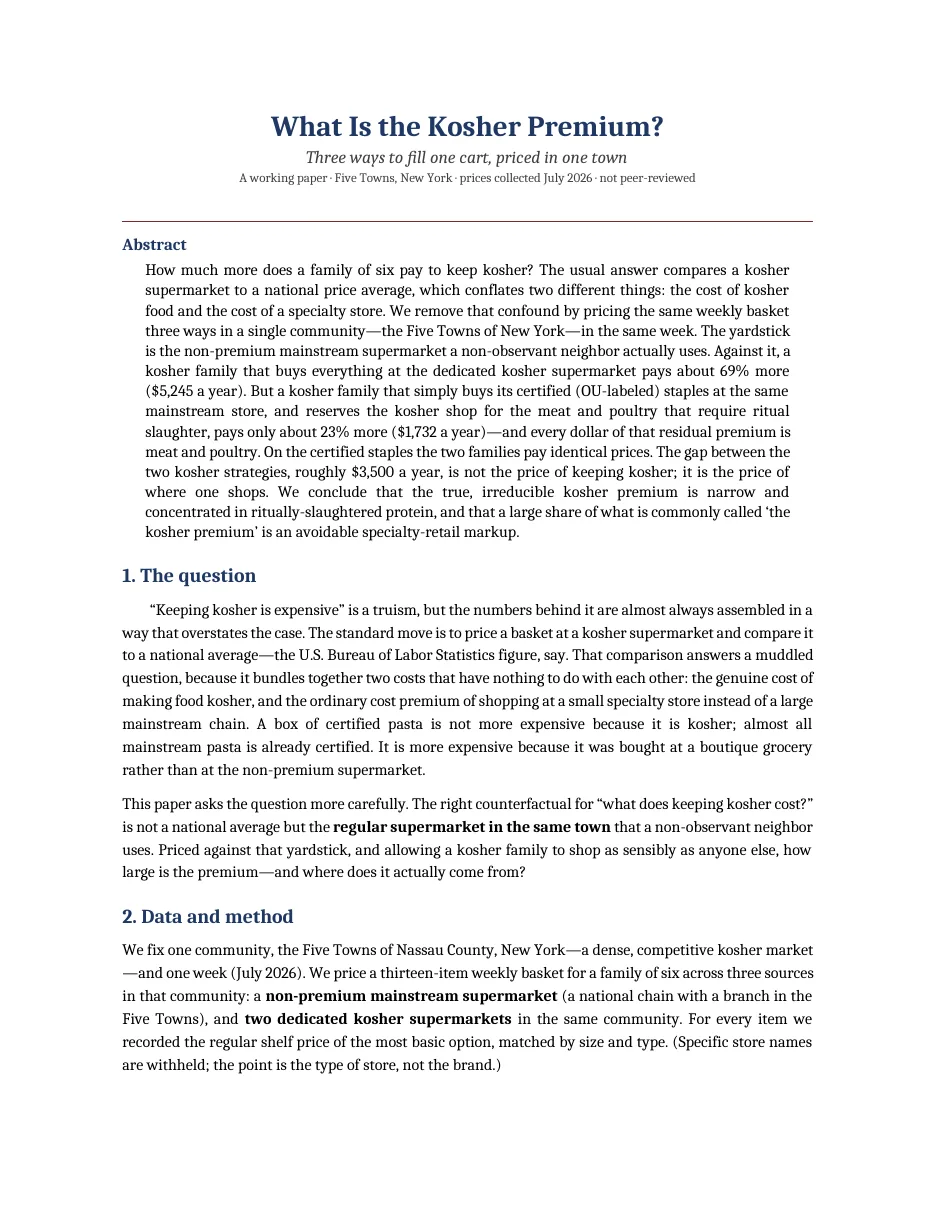
The core of this story is one community priced in one week. We priced a thirteen-item weekly basket for a family of six (two adults, four children) three ways in the Five Towns of New York in July 2026: at a non-premium mainstream supermarket (a national chain with a branch in the Five Towns) and at two kosher supermarkets in the same community. The yardstick is what a non-observant neighbor pays at the non-premium supermarket. The smart split buys every certified (OU-labeled) staple there at that same price and sources only the fresh meat and poultry, which require ritual slaughter, from the cheapest kosher option; the non-premium supermarket itself stocks a national kosher brand's chicken cutlets ($7.99/lb) and ground beef ($8.99/lb), so most kosher meat needs no separate trip. The all-kosher basket buys everything at the cheaper of the two kosher stores, which makes the 69% premium a conservative figure. Specific store names are withheld by design; what matters is the type of store.
We treat any reliably certified product as acceptable, including cholov stam dairy (dairy under general kosher supervision), the common practice. A household that keeps cholov yisroel (dairy supervised from milking) must buy milk and cheese from the kosher supply, which lifts the smart-split premium from 23% to about 39% (~$3,000/yr), still far below buying everything at the kosher store, and the shape of the finding holds.
Supporting sections use the U.S. national average price (Bureau of Labor Statistics) as a second non-kosher reference and add kosher stores in Los Angeles, Denver, and Chicago, a two-store audit that shows the same kosher item swinging 18–20% between stores in one city, and a national kosher shipper to price the extreme case of a community with no local store at all.
The basket is a fixed thirteen-item comparison basket meant to isolate the premium rather than to capture a household's full grocery bill; it excludes Shabbat and holiday meals, whose kosher meat, wine, and challah add a substantial cost we treat separately.
One town, one week, online snapshots. The mainstream figures come from a regional non-premium supermarket's storefront, a few pack-size conversions were computed rather than observed, and a handful of national-baseline items are estimated. Extending the three-way, same-town design to other cities is the natural next step. The direction and magnitude are robust; the exact dollars are good-faith snapshots.
The paper behind this story
A data project on how Jewish life is paid for. The work comes in seasons. This page is part of Season 2 — Household Affordability. It states its own sources, sample sizes and limits.
Ahead: more in Season 2 — Household Affordability · Season 3 — Federation & Charitable Giving
Working prototype. Every figure comes from the underlying research; where a chart simplifies a result, the page says so. Nothing here audits an individual store, and store names are withheld by design.